
SDA Doctrine versus Bible Truth: The Millennium
In brief, SDAs...
- Teach the Millennium will take place up in heaven
Seventh-day Adventists teach the following about the Millennium: 1. At the Second Coming of Christ, the wicked are slain and the righteous are whisked away to heaven. Angels 'gather together His elect from the four winds, from one end of heaven to the other.' Little children are borne by holy angels to their mothers' arms. Friends long separated by death are united, nevermore to part, and with songs of gladness ascend together to the City of God.1 2. The wicked are annihilated and the earth is left empty and desolate for a period of 1,000 years: At the coming of Christ the wicked are blotted from the face of the whole earth—consumed with the spirit of His mouth and destroyed by the brightness of His glory. Christ takes His people to the City of God, and the earth is emptied of its inhabitants.2 3. Satan is left to wander the earth alone during the Millennium: And as the scapegoat was sent away into a land not inhabited, so Satan will be banished to the desolate earth, an uninhabited and dreary wilderness.3 4. The saints spend the Millennium in heaven. Their "reign" is limited to judging the dead. At His second advent Christ takes His followers to heaven... But in what sense can the saints be said to reign if they are in heaven and all the wicked are dead? Their reign will consist of involvement...in judgment...4
5. At the close of the 1,000-year Millennial period, the wicked are raised to life upon the earth, and form an army under the leadership of Satan. "Christ again returns to the earth" in a Third Coming with the saints, and he destroys all the wicked with fire.5
|
SDA teachings on the Millennium are different from nearly all other Christian denominations. Here is how:
1. The location of the reward of the righteous The Bible teaches that the reward for the righteous is to inherit the earth, not heaven: Blessed are the meek, for they shall inherit the earth (Matt. 5:5). The righteous shall never be removed: but the wicked shall not inhabit the earth (Prov. 10:30). Behold, the righteous shall be recompensed in the earth... (Prov. 11:31). Jesus told his disciples He was going away to prepare mansions for the saints: I go to prepare a place for you. And if I go and prepare a place for you, I will come again, and receive you unto myself; that where I am, [there] ye may be also (John 14:2-3). SDAs use this passage as the single proof-text that the Millennium is in heaven, but follow the location of Jesus carefully:
Now, stop right here. Where is Jesus located when he "comes again" for the righteous? At that point, He is at planet earth. The passage does not say the saints are going back with Him to heaven. Paul writes that we will meet the Lord in the air above the earth (1 Thes. 4:17). In ancient times, whenever an emperor was coming to visit a city in the Roman Empire, the people would go outside of the city and line the streets to greet him. When he arrived at the city, he wouldn't turn around and leave. He entered the city along with the people following behind him. When the saints meet the Lord in the air, that doesn't imply they are then transported back to heaven. They will return with the king to the city of Jerusalem, where he will rule and reign for a thousand years (Bible verses???).
Jesus is not saying that he will live in the air with the saints. Jesus is simply stating that the He and the disciples will be together again, never to be separated. They will be placed on thrones upon the earth to rule the twelve tribes of Israel (verse ???) The mansions that Jesus prepared are presumably inside the beautiful city, the New Jerusalem, that will descend upon the new earth at the end of the Millennium. As the New Jerusalem descends upon the new earth, John hears a voice say: And I John saw the holy city, new Jerusalem, coming down from God out of heaven, prepared as a bride adorned for her husband. Behold, the tabernacle of God is with men, and he will dwell with them, and they shall be his people, and God himself shall be with them, and be their God (Rev. 21:2-3). John describes the New Jerusalem as a "bride adorned for her husband," indicating a pristine and "virgin" city, not one that the saints are about to re-occupy after having already lived there for 1,000 years! If the saints had already been living up in heaven in their mansions in the New Jerusalem for 1,000 years, this could hardly be the special event John is describing. This verse also announces a new era for mankind. The Father will be physically with them. They will live together in the same city. Think this through: This announcement, that God will now be dwelling with men, would not make any sense if the righteous had already been dwelling with God in heaven for the past 1,000 years!
| ||||||||||||||||||||||||
|
2. Is the Earth void (empty) during the Millennium? SDA Prophetess Ellen White saw the earth as an "uninhabited wilderness," void of all life during the Millennium. Is the earth actually desolate during the Millennium? The Bible teaches that birds are found on earth during the Millennium: And I saw an angel…saying to all the fowls that fly in the midst of heaven, Come and gather yourselves together unto the supper of the great God…and all the fowls were filled with their flesh (Rev. 19:17,21). Plants and animals will inhabit the destroyed cities of the wicked during the Millennium: For the indignation of the LORD is upon all nations, and his fury upon all their armies: he hath utterly destroyed them, he hath delivered them to the slaughter…But the cormorant and the bittern shall possess it; the owl also and the raven shall dwell in it… And thorns shall come up in her palaces, nettles and brambles in the fortresses thereof: and it shall be an habitation of dragons, and a court for owls. The wild beasts of the desert shall also meet with the wild beasts of the island, and the satyr shall cry to his fellow; the screech owl also shall rest there, and find for herself a place of rest. There shall the great owl make her nest, and lay, and hatch, and gather under her shadow: there shall the vultures also be gathered, every one with her mate (Isa. 34:2,11,13-15). The Bible also teaches that humans occupy the earth during the Millennium. Parts of Isaiah 24 are often quoted by SDAs to describe the condition of the earth during the Millennium. Other parts of the same chapter clearly state that there are inhabitants on the earth during that time: Behold, the Lord maketh the earth empty, and maketh it waste, and turneth it upside down, and scattereth abroad the inhabitants thereof (Isa. 24:1). This verse proves that there are indeed inhabitants of the earth and that they are "scattered abroad" throughout the planet. Isaiah continues: Therefore hath the curse devoured the earth, and they that dwell therein are desolate; therefore the inhabitants of the earth are burned, and few men left (Isa. 24:6). This verse describes in detail the status of the inhabitants on the earth during the Millennium. They "dwell" on the earth and there are "few" left. Isaiah does not teach there are "none" left. He says there are "few" left. The Hebrew word for "few" is miz`ar, which means "a remnant, a very few."6 SDAs seem to believe that "few" means "none" but this is not the case. Isaiah used a different Hebrew word for none, 'ayin (Is. 41:24; 45:21).
| ||||||||||||||||||||||||
|
3. Is Satan Roaming Earth During the Millennium? Revelation teaches that Satan is bound for 1,000 years in the "bottomless pit": And he laid hold on the dragon, that old serpent, which is the Devil, and Satan, and bound him a thousand years, and cast him into the bottomless pit, and shut him up, and set a seal upon him, that he should deceive the nations no more, till the thousand years should be fulfilled (Rev. 20:2,3). The phrase "bottomless pit" comes from the Greek word abussos which Strong's defines as: A very deep gulf or chasm in the lowest parts of the earth used as the common receptacle of the dead and especially as the abode of demons.7 It is used nine times in the Bible and never refers to the inhabitable regions of the earth. Satan was cast down to this earth after he was expelled from heaven (Rev. 12:9). Revelation 20:1-3 depicts the movement of Satan from his current abode, the earth, to a prison, possibly within the lower regions of the earth, described as a "bottomless pit." From this region Satan is unable to tempt or harass those upon the earth for 1,000 years. Paul makes it clear that the Abyss is not the inhabitable earth: But the righteous which is of faith speaketh on this wise, Say not in thine heart, Who shall ascend into heaven? (that is, to bring Christ down from above:) Or, Who shall descend into the deep [abussos]? (that is, to bring up Christ again from the dead) (Rom. 10:6,7). This verse tells us that Jesus went into the "bottomless pit" when He died. The souls of the dead were thought to enter the abyss—the underworld beneath the surface of the earth—when they died. This is a place separate from the land of the living. It is not in the inhabitable regions of the earth.
| ||||||||||||||||||||||||
|
4. Is the reign of the saints limited to judging the dead? Revelation 20:6 says the saints will "reign" during the Millennium, and Paul says "we shall also reign with him" (2 Tim. 2:12). Even the SDA publication on doctrine is forced to ask the obvious question, "in what sense can the saints be said to reign if they are in heaven and all the wicked are dead?" That is a very important question for SDAs to consider! What exactly are the SDA saints in heaven reigning over? Angels? No, according to SDAs, the reign consists entirely of judging the dead. But SDAs insist that the saints will not actually be judging the dead in the sense of deciding cases, for "God makes that decision before the Second Advent" during the Investigative Judgment.8 So then, what does the judging consist of? It consists of reviewing the cases of the dead. So, SDAs claim the saints will be auditors, not kings. Apparently SDAs do not have much confidence in God's ability to judge, since they imagine themselves spending 1,000 years going over the records so that they can assure themselves (and the rest of the watching universe) that God was fair. That does not sounds like much of a reign! Rather, this 1,000-year audit sounds like a huge waste of time! The word "reign" used in Rev. 20:6 is from the Greek word basileuo, which means: To be king, to exercise kingly power, to reign.9
Reigning may indeed include the aspect of judging (not reviewing), but it also means to exercise kingly power and authority. There is a vast difference between "reigning" and "reviewing cases of the dead!" If the only reigning the saints are going to do during the Millennium is reviewing cases, then why didn't John use the word "judge" (Greek krin) instead of "reign?" John was certainly familiar with the word "judge" (krin), since he used the word 24 times in his writings, including Rev. 20:12 (a mere 6 verses after Rev. 20:6). If John had wanted to convey the idea that the saints would be judging, not reigning, during the Millennium, he certainly could have chosen to use the word "judge" (krin). However, he did not. He said the saints would "reign" with Christ.
| ||||||||||||||||||||||||
|
5. At the end of the Millennium, are the wicked dead resurrected upon the earth to form a Satanic army to attack the New Jerusalem? SDAs have a most unusual teaching about the end of the Millennium. The wicked are resurrected, appear before the White throne of God to be judged, and are then placed back on earth to live again for years or even decades while their associates in evil are appearing before God in judgment. Apparently SDAs believe God is as slow at the White Throne Judgment as He was during the Investigative Judgment. During this period in time the wicked begin developing weapons and training for war. Finally, when the judgment appearances of all the wicked are complete, the New Jerusalem, with Jesus and the saints inside, sets down upon the earth. Then, Satan leads an army of all the wicked from throughout all the ages and attacks the New Jerusalem. Ultimately, Satan and his army lose the battle and he and all his wicked cohorts are destroyed by fire. While this is an interesting piece of fiction, it does not fit the Biblical description of events at all. Revelation 20:7-15 explains the events of the Millennium in precise chronological detail:
It is obvious from this chronology that the wicked dead are raised after the Satanic army has already been destroyed and Satan thrown into the lake of fire. The wicked are not given a "second chance" to attack and torment God's people. The wicked are raised to appear before the white throne in judgment and then are immediately cast into the lake of fire to suffer the second death. There is nothing in this passage to suggest they are placed back on the earth to assault the righteous. SDAs are forced to twist the chronology of events in Revelation 20 because they erroneously teach the earth is empty of humans during the Millennium. Since there are no humans alive to attack Jerusalem, the only way to get wicked humans on the earth during the Millennium is to pretend that God sent the wicked back to earth after raising them to be judged at the white throne judgment. However, such a contrived view does not fit the chronology of Revelation 20. Neither does it make any sense for God to permit such an action by the wicked. What judge allows dangerous prisoners who have already been condemned and sentenced to death to be freed for a while to torment and attempt to wreak havoc on the righteous? No judge in his right mind would do this. Likewise, it is preposterous to think that God is going to resurrect the wicked and put them back on earth so they can make one final attack against the righteous. SDAs are forced to twist the chronology even further since they teach there is no occupied city of Jerusalem upon the earth during the Millennium for Satan to attack. So, in order to supply an occupied city of "Jerusalem" for the wicked throng to attack, SDAs are forced to make the New Jerusalem descend upon the earth prior to the creation of the new heavens and the new earth. The Bible, on the contrary, teaches the New Jerusalem does not descend until after the new earth has been created (Rev. 21:1-2). Notice below how the Bible chronology flows in perfect, logical order, while SDAs are forced to swap the events around and invent events not described in the Bible in order to make their system work:
|
1. God will stand upon this earth at the Second Coming! Job's idea of the Second Coming of Christ contrasts sharply with the SDA view. Instead of God grabbing the saints in the air and whisking them away to somewhere in heaven without ever touching the earth, Job says that he will witness his redeemer standing upon the earth: For I know that my redeemer liveth, and that he shall stand at the latter day upon the earth: And though after my skin worms destroy this body, yet in my flesh shall I see God (Job 19:25,26). The angels explained to the disciples how Christ would return: ...Jesus, which is taken up from you into heaven, shall so come in like manner as ye have seen him go into heaven (Acts 1:11). What was the "manner" of Jesus being taken up into heaven?
Therefore, if He is going to return "in like manner", then what is the reverse of this process?
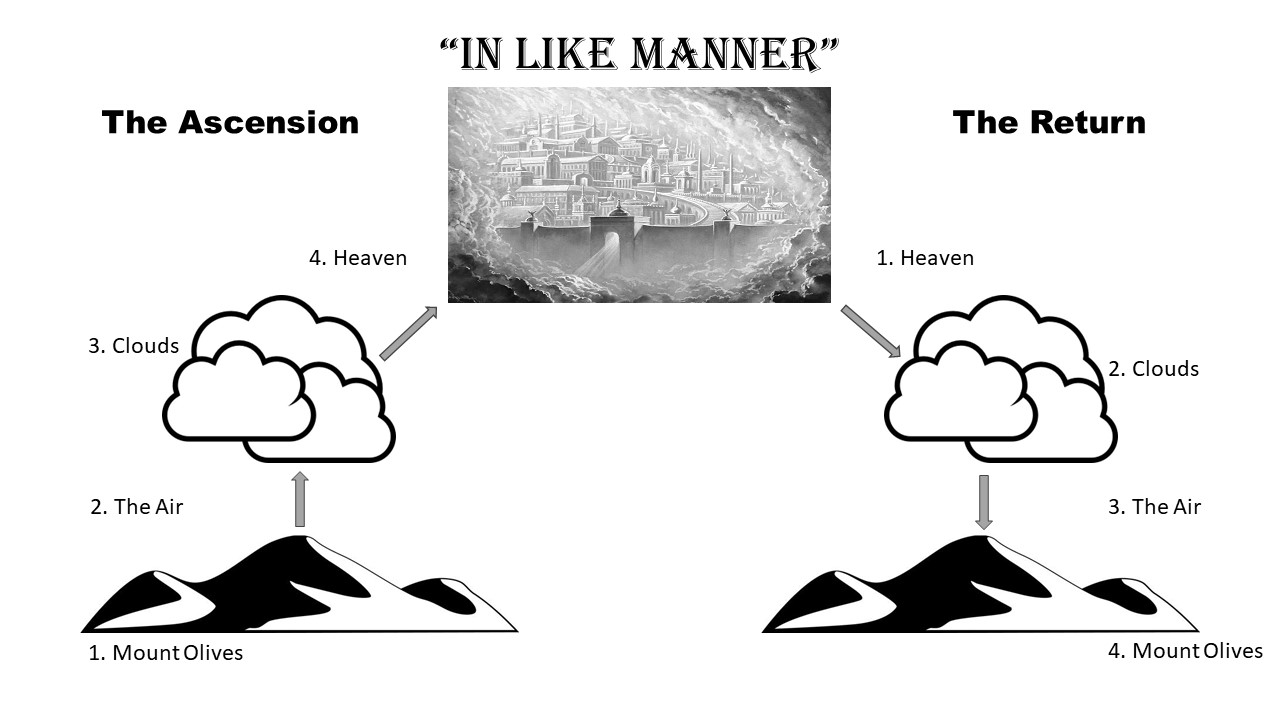
The Bible clearly teaches that in the "day of the Lord," ...his feet shall stand in that day upon the mount of Olives... (Zech. 14:1,4) 2. Saints live on Earth during the Millennium The Bible teaches that at the Second Coming many of the wicked are slain (Rev. 19:15,17,20,21; also Isa. 34, 11:4, Jer. 25:29-33, 2 Thes. 2:8, Zech. 14:12, Micah 4:13, Isa. 66:15,16). The righteous dead are raised to life and "we which are alive and remain shall be caught up together with them in the clouds, to meet the Lord in the air." (1 Thes. 4:17). The question is, after we meet the Lord in the air, do we return back down to the earth? Or do we go up to heaven? The book of Revelation states that the resurrected righteous will rule with Jesus for 1,000 years: Blessed and holy is he that hath part in the first resurrection: on such the second death hath no power, but they shall be priests of God and of Christ, and shall reign with him a thousand years (Rev. 20:6). The question is, what are the righteous "reigning" over? What is their kingdom? Are they reigning over heaven? Or earth? The Bible clearly states that the righteous shall reign "upon the earth": And hast made us unto our God kings and priests: and we shall reign on the earth (Rev. 5:10). Does it make any sense for the righteous to be ruling over some part of heaven? No, of course not! The Bible teaches that mankind was created to "have dominion" over "the earth," not heaven (Gen. 1:26-28). But who will the saints rule over? Aren't all the unsaved killed when Christ returns? As noted above, Isaiah 24 says a small remnant of people are left alive. SDAs interpret Isaiah 24 as a passage pertaining to the Millennium. However, as shown below, Ellen White in her book The Great Controversy quotes Isaiah 24, but leaves out parts that show people are alive upon the earth during the Millennium. Notice the passage from her book below. All the Biblical words that Ellen White deleted have been inserted in red. These words reveal an entirely different picture than the one painted by Ellen White: "At the coming of Christ the wicked are blotted from the face of the whole earth—consumed with the spirit of his mouth and destroyed by the brightness of his glory. Christ takes his people to the city of God, and the earth is emptied of its inhabitants. 'Behold, the Lord maketh the earth empty, and maketh it waste, and turneth it upside down, and scattereth abroad the inhabitants thereof.' 'The land shall be utterly emptied, and utterly spoiled: for the Lord hath spoken this word.' [The earth mourneth and fadeth away, the world languisheth and fadeth away, the haughty people of the earth do languish. The earth also is defiled under the inhabitants thereof;] 'Because they have transgressed the laws, changed the ordinance, broken the everlasting covenant. Therefore hath the curse devoured the earth, and they that dwell therein are desolate: therefore the inhabitants of the earth are burned'[, and few men left.] (Isaiah 24:1, 3, 5, 6)."10 Notice several important facts White left out of the Holy Bible's account:
For some reason God does not destroy all the wicked. Perhaps these are descendants or relatives of the saints or others for whom there is still some hope of salvation. Perhaps these are people whose services are needed during the Millennium to maintain the earth, farm its land, and provide other needed services for the saints. A "few" people can turn into many millions over the course of 1,000 years. During this time the righteous saints will "reign" on the earth" over these nations. 3. God's kingdom is set up on earth! The prophet Daniel teaches that Christ's kingdom is established upon the earth and is described by Daniel as a "mountain" upon the earth: …and the stone that smote the image became a great mountain, and filled the whole earth… And in the days of these kings shall the God of heaven set up a kingdom, which shall never be destroyed: and the kingdom shall not be left to other people, but it shall break in pieces and consume all these kingdoms, and it shall stand for ever (Dan. 2:35,44; see also Micah 4:1, Isa. 11:9). Daniel states that God will destroy the kingdoms of this earth and "in those days" will establish a kingdom that fills "the whole earth"—not heaven—and would "stand for ever." Daniel says nothing about God's kingdom being "in heaven" or being turned over to Satan for 1,000 years while the saints are up in heaven auditing God's work. Daniel says the kingdom will be established in the earth and that kingdom will rule for ever. Zechariah teaches that the Lord will set up his kingdom upon the earth: Behold, the day of the LORD cometh ... Then shall the LORD go forth, and fight against those nations... And his feet shall stand in that day upon the mount of Olives, which [is] before Jerusalem ... And it shall be in that day, [that] living waters shall go out from Jerusalem... And the LORD shall be king over all the earth: in that day shall there be one LORD, and his name one... (Zech. 14:1,3,8,9). During this time "we shall also reign with him" and "we shall reign on the earth." (1 Ti. 2:12, Rev. 5:10). Who are the righteous reigning over? Zechariah gives indisputable proof that a remnant of unsaved people who were not destroyed at Christ's Second Coming will inhabit the earth. Notice from Zechariah 14:
SDAs claim that since the Father's throne is in heaven, the saints will be occupying the throne in heaven, not upon earth (Rev. 15:2). However, Revelation 20:6 says the saints will be reigning with Christ. Christ's throne is not in heaven, for He sits on the right hand of the throne of God, taking the position of a prince. The Bible teaches that Christ's throne is this earth: "He shall be great, and shall be called the Son of the Highest: and the Lord God shall give unto Him the throne of his father David and He shall reign over the house of Jacob forever; and of His Kingdom there shall be no end" (Luke 1:32, 33). Jesus is coming back to inherit David's throne, as king over the Jews and all those who have been grafted in during the Christian era. That is an earthly throne. Notice how God promises a king will reign on the earth: "Behold, the days come, saith the LORD, that I will raise unto David a righteous Branch [a descendent from David], and a King shall reign and prosper, and shall execute judgment and justice in the earth." (Jeremiah 23:5). Isaiah 11 describes the coming king who will slay the wicked and reign over the earth during an era of peace, when even the animals will be at peace: And there shall come forth a rod out of the stem of Jesse, and a Branch shall grow out of his roots: And the spirit of the LORD shall rest upon him... But with righteousness shall He judge the poor, and reprove with equity for the meek of the earth and He shall smite the earth with the rod of His mouth, and with the breath of His lips shall He slay the wicked ... The wolf also shall dwell with the lamb, and the leopard shall lie down with the kid; and the calf and the young lion and the fatling together; and a little child shall lead them... (Isaiah 11:1,2,4,6). Various Old Testament prophets testify that the Lord will rule the earth from Jerusalem: And it shall come to pass, in the last days, that the mountain of the Eternal's house shall be established in the top of the mountains, and shall be exalted above the hills; and all nations shall flow unto it! And many people shall go and say, "come ye, and let us go up to the mountain of the LORD, to the house of the God of Jacob; and He will teach us of His ways, and we will walk in His paths: for out of Zion shall go forth the law, and the word of the LORD from Jerusalem" (Isaiah 2:2-3). ... and the LORD shall reign over them in Mount Zion from henceforth, even forever! (Micah 4:7). The LORD said unto my Lord, Sit thou at my right hand, until I make thine enemies thy footstool. The LORD shall send the rod of thy strength out of Zion: rule thou in the midst of thine enemies (Ps. 110:1,2). Other parallel passages in the Psalms refer to the Millennium, describing a time when the kingdoms of this earth will serve the Lord.11 The Biblical evidence is heavily weighted towards the kingdom of Jesus being established upon this earth at Jerusalem during the Millennium. 4. The saints are living on the earth when Satan is loosed At the end of the thousand years, when Satan is released for a season, the Bible clearly states that the righteous are living upon the earth at that time. Notice carefully in the text below that the righteous are living in "the beloved city." Remember, this city could not possibly be the New Jerusalem because it does not descend to earth until after the first earth passes away (see Rev. 21:1,2). And when the thousand years are expired, Satan shall be loosed out of his prison, And shall go out to deceive the nations which are in the four quarters of the earth, Gog and Magog, to gather them together to battle: the number of whom is as the sand of the sea. And they went up on the breadth of the earth, and compassed the camp of the saints about, and the beloved city (Rev. 20:7-9; also Ezek. 38,39). Could it be any plainer? The saints are occupying the earth, the old Jerusalem, when Satan is loosed at the end of the Millennium. Satan gathers an army from among the heathen nations living upon the earth during the Millennium and assaults Jerusalem.
ConclusionWhile we have only a limited understanding of the Millennium, the weight of Biblical evidence presented above indicates:
The SDA teaching of a Millennium in heaven places them in a very difficult position of having to try and explain away the dozens of obvious references to an earthly Millennium in the Bible. SDAs have never been able to adequately explain away all of these verses and the preponderance of Biblical evidence is heavily weighted against their view.
|
QUESTION: Yes, Isaiah 24 is quoted by Adventists when referring to the Millennium. However, in that passage, the word "inhabitants" is used. Couldn't that refer to animals that inhabit the earth and not to humans? ANSWER: Isaiah 24:1 refers to "inhabitants," and verse 2 identifies them as "people," including such professions as priests, servants, masters, maids, mistresses, buyers, sellers, lenders, and borrowers. Obviously, animals do not engage in these professions. Verse 4 again refers to "people," and verse 5 says the "inhabitants" have transgressed the laws. The law was made for people, not animals. Finally, the Hebrew word for "men" in Isa. 24:6 (KJV) is 'enowsh, which is Hebrew for mankind, referring to the "human race" (Gesenius's Lexicon). It is never used in the Bible to refer to an animal. QUESTION: The events of Revelation do not always happen in chronological order, so why is it wrong for Adventists to change the order of events in Rev. 20? ANSWER: Revelation does not follow a chronological order from chapter 1 to chapter 22. However, Revelation is a highly structured book divided up into various sections. Nearly all Christians agree that within those sections, a chronological order is followed. Unless there is a parenthetical break, there is no reason to disbelieve the chronology presented within a section. There is nothing in the section on the Millennium (Rev. 20) indicating a parenthetical break, and therefore, there is no reason to re-order the chronology. Seventh-day Adventism is forced to twist the events of the Millennium because the Biblical chronology makes no sense if the earth is completely de-populated as the SDAs propose. If SDAs were to agree with the weight of Biblical evidence that the Millennium takes place upon the earth, then they could simply accept the chronology of Rev. 20 at face-value as it is written without having to contort it.
QUESTION: Doesn't Luke 17:26-30 prove that ALL the wicked will be destroyed at Christ's Second Coming? ANSWER: Let us take a look at the passage in question: "As it was in the days of Noah, so will it be in the days of the Son of man. They ate, they drank, they married, they were given in marriage, until the day when Noah entered the ark, and the flood came and destroyed them all. Likewise as it was in the days of Lot--they ate, they drank, they bought, they sold, they planted, they built, but on the day when Lot went out from Sodom fire and sulphur rained from heaven and destroyed them all-- so will it be on the day when the Son of man is revealed." (Luke 17:26-30 RSV) First, let us consider the flood. God said unto Noah: Come thou and all thy house into the ark; for thee have I seen righteous before me in this generation. (Gen. 7:1) Noah's entire household was spared from destruction because of the righteousness of Noah, although we know from later Biblical accounts that Ham was a questionable character (Gen. 9:22-23). Likewise, the Bible calls Lot "just" (2 Pet. 2:7), but when Sodom was destroyed, Lot's family was spared even though later accounts show his daughters did not exhibit the same character as their father (Gen. 19:33-36). If God continues the same pattern as before, then we can expect to see all the wicked destroyed at the Second Coming, and the righteous and their families will be spared. The righteous will obtain immortality, and by God's great mercy, those of their families who are unsaved will be spared the destruction of the wicked for the sake of their righteous parents. This is no doubt because God does not wish pain and suffering upon His righteous ones. These unsaved souls will inhabit the earth in their natural state and be under the rule of Jesus and the righteous. These will apparently be gifted with long life as is indicated by Isaiah: There shall be no more thence an infant of days, nor an old man that hath not filled his days: for the child shall die an hundred years old; but the sinner [being] an hundred years old shall be accursed. (Isa. 65:20) SDAs reject the idea that unsaved people will populate the earth during the Millennium, but they have no meaningful explanation for the above passage or Zechariah 14 which both clearly state that "heathen" and "sinners" will be present on the earth during the Millennium. The Bible does not explicitly tell us who these "heathen" and "sinners" are, but if God follows the same pattern as He did with Noah and Lot, and spares some of the families of the righteous even though they may not be righteous themselves, then these "heathen" and "sinners" may be the children or descendants of the children of the righteous. It is also possible that God may spare the lives of some people who are needed to farm the earth or provide services for the saints during the Millennium. There is no reason to believe that these people cannot be saved. In fact, Zechariah 14 indicates that many of them go to Jerusalem to worship God. These people will have the fortune of living upon an earth ruled by Jesus and judged by the righteous while Satan is bound in the abyss. There is no reason to believe that they cannot be saved and become a part of God's eternal kingdom. Sadly, though, many of these "heathen" and "sinners" will choose to side with Satan when he is loosed temporarily at the end of the Millennium. Satan will deceive these people into launching an attack upon Jerusalem, but they will be destroyed by fire from God (Rev. 20:7-9). Satan will then be cast into the lake of fire. Immediately after these events, Revelation describes a judgment scene in heaven, and "every man" was judged and "whosoever was not found written in the book of life was cast into the lake of fire" (Rev. 20:15). In God's eternal kingdom in the new earth, the earth will only be occupied by the saved.
QUESTION: Revelation 7:9-17 speaks of a great multitude in heaven. Doesn't this prove the saints are in heaven? ANSWER: If you look closely at this passage, it is describing the Eternal Kingdom, not the Millennium. Notice the parallels between this passage and the passage in Rev. 21 describing the eternal kingdom (after the New Jerusalem has descended to earth).
Revelation 7 is describing the saints assembled before the throne of God on earth during the eternal kingdom. This is proven by the similarities in language to Revelation 21 which is describing events in the eternal kingdom.
|
|


Citations
1. Ellen G. White, Great Controversy (1911), 645.
2. Ibid., 657.
3. Ibid.
4. Seventh-day Adventists Believe (1989), 366.
4. Great Controversy, 662.
6. Strong's. In Scripture, Isaiah is the only author who uses the Hebrew word miz`ar in his writing. Only one other time in the book of Isaiah is the word used to indicate a small number, and that is in Isaiah 16:14, "and the remnant {miz`ar} [shall be] very small [and] feeble."
7. Strong's.
8. Seventh-day Adventists Believe, 367.
9. Strong's.
10. Great Controversy, 657. Isa. 24:4 and part of Isaiah 24:6 have been entered into the text in the color red to illustrate how Mrs. White removed part of the Scripture which contradicted the SDA position on the Millennium.
11. "To declare the name of the LORD in Zion, and his praise in Jerusalem; When the people are gathered together, and the kingdoms, to serve the LORD." (Ps. 102:21-22) "All the ends of the world shall remember and turn unto the LORD: and all the kindreds of the nations shall worship before thee. For the kingdom [is] the LORD'S: and he [is] the governor among the nations." (Ps. 22:27-28)